Email Parser Discrepancy in Nodemailer
Discovering two email parsing issues in Nodemailer that could lead to email misrouting. The first was patched in v6.9.16, and the second was finally patched in v7.0.7 after I reported it as a security advisory.
Email Parser Discrepancy in Nodemailer
TL;DR
- This blog reveals two issues in Nodemailer’s email address parser. The first was fixed in
v6.9.16. - The second issue was later reported as a security advisory and patched in
v7.0.7. See GHSA-mm7p-fcc7-pg87.
After reading Splitting the Email Atom research, I set out to find a zero-day bug in Nodemailer for one of my CTF challenges. I discovered that Nodemailer was not correctly parsing certain valid email addresses. Consider this example:
"test@0xhexr4.htb"@google.comAccording to RFC 5322, this is a valid email address. The portion "test@0xhexr4.htb" is a quoted local-part, which allows the @ character. The domain is google.com. Thus, the mailbox is "test@0xhexr4.htb" at the domain google.com.
However, Nodemailer’s parser attempts to identify the address by splitting at the first @ found outside of a properly recognized quoted local-part. Here’s a snippet (taken from Nodemailer’s code) showing how it separates tokens into different lists:
data = {
    address: [],
    comment: [],
    group: [],
    text: []
};
When Nodemailer encounters "test@0xhexr4.htb"@google.com, it correctly identifies the quoted string "test@0xhexr4.htb" as the local-part, but then treats the subsequent @google.com segment as non-quoted “text.” It fails to recognize that google.com is the domain. Instead, it might parse the input as:
[{
    name: "@google.com",
    address: "test@0xhexr4.htb"
}]
This results in Nodemailer interpreting "test@0xhexr4.htb" as the entire mailbox and @google.com as a display name, effectively losing the actual domain information (google.com).
I reported this to the Nodemailer team, hoping it might be treated as a security issue, since incorrect parsing could lead to emails being sent to the wrong domain. However, they considered it a regular bug rather than a security flaw. They fixed this issue in version 6.9.16 without providing credit.
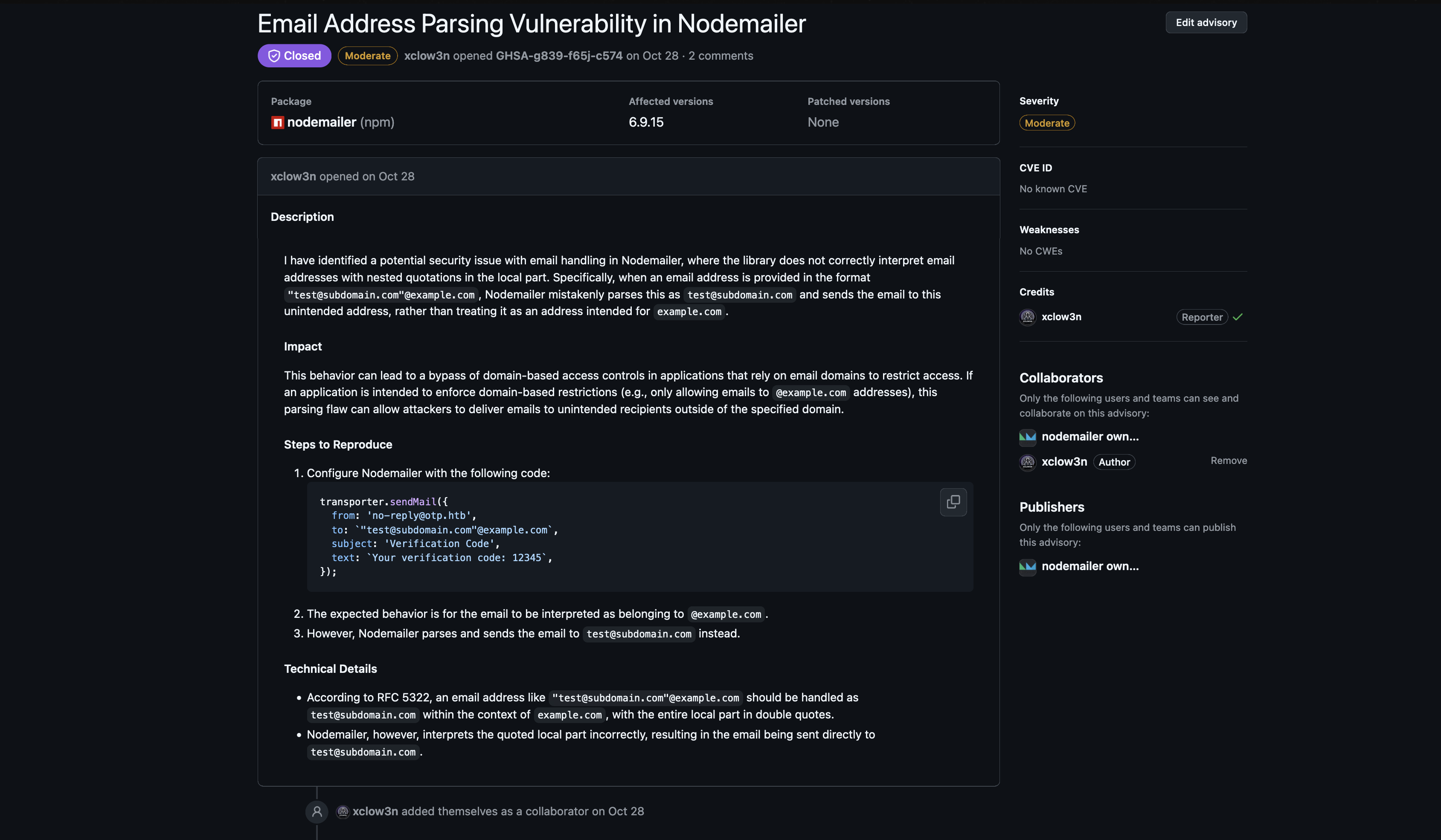
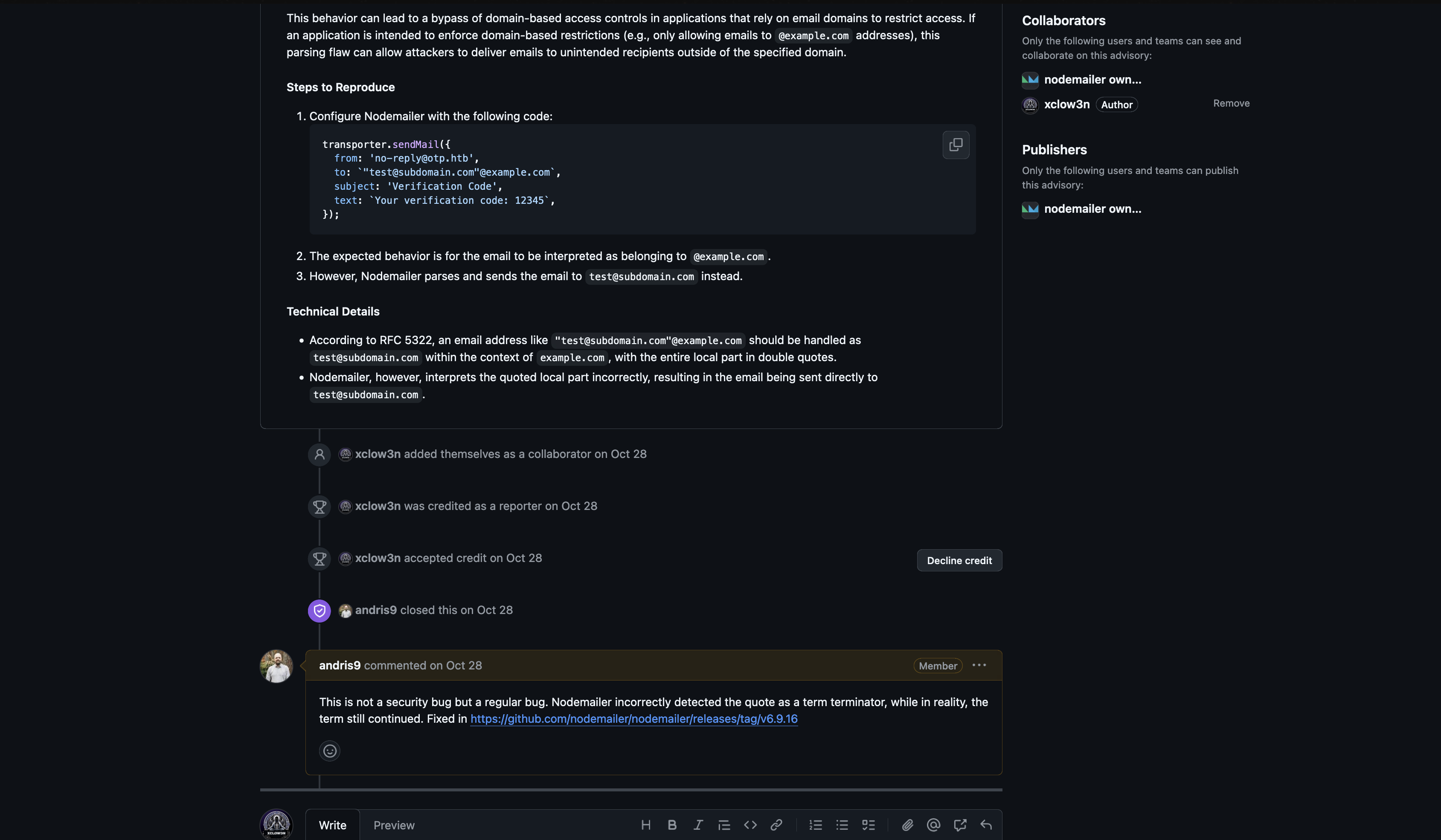
Nodemailer Zero Day
Accepting their stance, I moved on and found another problem. I found out that it is still vulnerable to the same kind of issue. For example, consider this payload:
"test@email.htb x"@interstellar.htbIt exhibits similar behavior, and the email is sent to the test mailbox on email.htb rather than interstellar.htb.
If we parse the following email using a library such as Email-Addresses:
Welcome to Node.js v23.3.0.
Type ".help" for more information.
> addrs = require("email-addresses")
[Function: parse5322] {
    parseOneAddress: [Function: parseOneAddressSimple],
    parseAddressList: [Function: parseAddressListSimple],
    parseFrom: [Function: parseFromSimple],
    parseSender: [Function: parseSenderSimple],
    parseReplyTo: [Function: parseReplyToSimple]
}
> addrs.parseOneAddress(`"test@email.htb x"@interstellar.htb`)
{
    parts: {
    name: null,
    address: {
        name: 'addr-spec',
        tokens: '"test@email.htb x"@interstellar.htb',
        semantic: 'test@email.htb x@interstellar.htb',
        children: [Array]
    },
    local: {
        name: 'local-part',
        tokens: '"test@email.htb x"',
        semantic: 'test@email.htb x',
        children: [Array]
    },
    domain: {
        name: 'domain',
        tokens: 'interstellar.htb',
        semantic: 'interstellar.htb',
        children: [Array]
    },
    comments: []
    },
    type: 'mailbox',
    name: null,
    address: 'test@email.htb x@interstellar.htb',
    local: 'test@email.htb x',
    domain: 'interstellar.htb',
    comments: '',
    groupName: null
}
>
The domain is “interstellar.htb”. I showcased this second bug in the University CTF 2024 Intergalactic Bounty web challenge.
Update: Second Issue Patched (October 2025)
I eventually reported this second issue as a security advisory to the Nodemailer team. The advisory was published as GHSA-mm7p-fcc7-pg87 and the issue was patched in v7.0.7 on October 6, 2025.
The core problem was identical to the first issue - the email parsing library incorrectly handles quoted local-parts containing @, leading to misrouting of email recipients where the parser extracts and routes to an unintended domain instead of the RFC-compliant target.
Payload: "xclow3n@gmail.com x"@internal.domain
Instead of sending to internal.domain, Nodemailer would extract and route the email to gmail.com. This could lead to:
- Email misdelivery / data leakage - emails sent to unintended external domains
- Filter evasion - logs and anti-spam systems bypassed by hiding recipients inside quoted local-parts
- Domain-based access control bypass in downstream applications using Nodemailer
Both issues are now fixed. These findings highlight how subtle RFC 5321/5322 parsing errors can lead to real security impact in widely-used libraries.